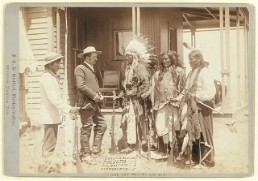
The native Americans were greatly affected by the railroad. It is sometimes considered to be one of the most
powerful weapons the white men had to drive the Indians off their lands and onto reservations. As was shown in the
Settlement screen, the railroad brought many white people to settle the west. These white people settled on miles
and miles of land, which had, for centuries, been the Indians' lands. The immense destruction of buffalo herds, as
described on the buffalo screen, nearly depleted one of their long established food and clothing sources.
The white men's attitude wasn't always very good towards them, as is shown here in as described by Colonel
Eldwell S. Otis:
"Like all savage people, the Indian has not the slightest conception of definite law as a rule of action. He is guided by his
animal desires. He practices all forms of vice, and even to a great extent those crimes which are pronounced as against nature..."
Obviously, a group of people with this attitude would probably have no qualms about forcing the Indians
off their lands. Chief Joseph, of the Nez Perce tribe, describes the cruelty of the whites:
"...Some of you think an Indian is like a wild animal. This is a great mistake. I will tell you all about our people, and then you
can judge whether an Indian is a man or not...
For a short time we lived quietly. But this could not last. White men had found gold in the mountains around the land of
winding water. They stole a great many horses from us, and we could not get them back because we were Indians. The white men
told lies for each other. They drove off a great many of our cattle. Some white men branded our young cattle so they could claim
them. We had no friends who would plead our cause before the law councils. It seemed to me that some of the white men in
Wallowa were doing these things on purpose to get up a war...."
Also, Santana, chief of the Kiowa Indians, in 1867:
“A long time ago this land belonged to our fathers; but when I go
up to the river I see camps of soldiers here on its bank. These
soldiers cut down my timber; they kill my buffalo; and when I see that, my heart feels like bursting; I feel sorry.”
Although these conflicts weren't caused specifically by the railroad, but the railroad gave the whites the upper
hand because now it was much easier to ship needed people and supplies hundreds or even thousands of miles in
a matter of days. By 1890, barely twenty years after the completion of the railroad, most Native Americans had
been pushed onto reservations.
